How peptide purity is tested, and what a certificate of analysis can't tell you
A purity figure comes from one method on one batch. Here is what each lab test measures, what it misses, and how to check a lot yourself.
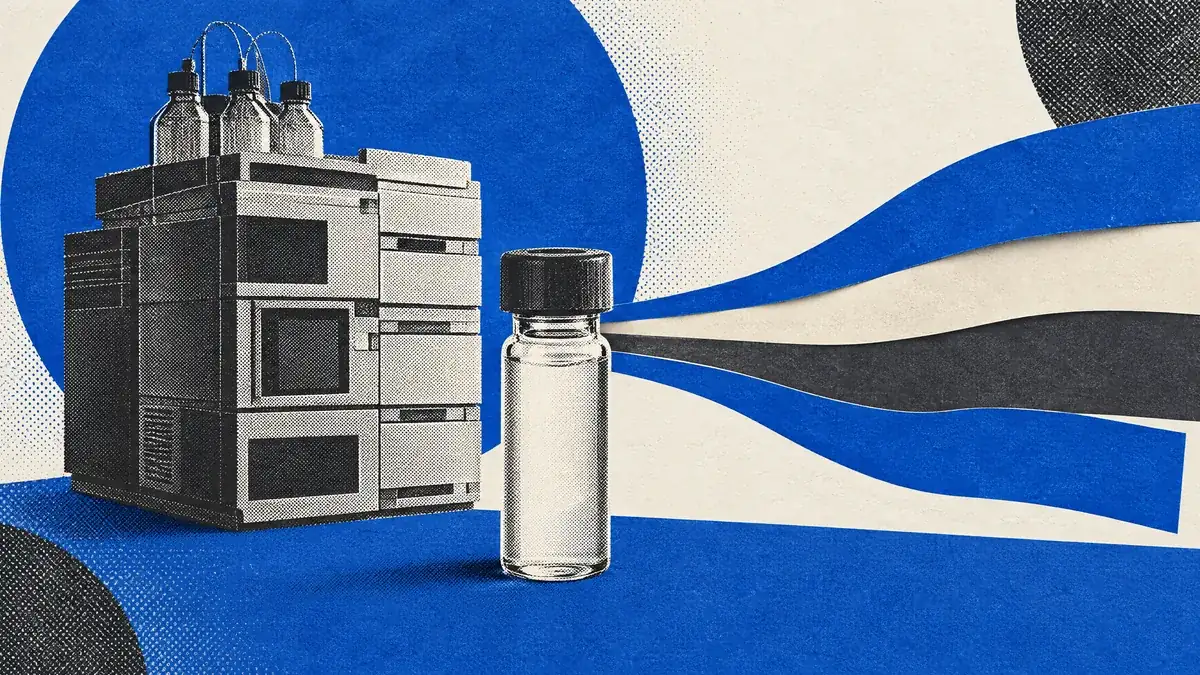
Peptide purity is usually tested by one method, reversed-phase HPLC with a UV detector, on one sample from one batch. The result is useful evidence and it is not a guarantee. A purity percentage says nothing on its own about which molecule is in the vial, how many milligrams are there, or whether it carries endotoxin, and published testing has found UV-invisible fillers that a purity figure could never show.
What the purity figure actually measures
Most peptide certificates report purity as a percentage from reversed-phase high-performance liquid chromatography (RP-HPLC) with ultraviolet detection. The sample is pushed through a column, its components separate by how they interact with the column, and each one reaches the detector at a different time. Purity is the area of the main peak as a share of all the peak area the detector saw.
That number answers a narrow question: how much of the UV-absorbing material behaves like the main component under those conditions. It is a ratio of detector response, not a weight. It also depends on the column, the gradient and the solvents chosen, which is why moving a peptide method from one system to another is treated as work to be validated rather than a formality [5]. Even within RP-HPLC, closely related impurities can sit under the main peak, and chemists use a second, differently selective method to separate them [4].
The bigger blind spot is anything the detector can't see. A compound that absorbs no UV light produces no peak, so it never enters the calculation. The analysts behind one study of commercial research peptides describe liquid-chromatography quality control as "blind" to certain impurities for exactly this reason [2].

What each test tells you, and what it does not
Each laboratory test answers one question. Purity, identity, content, endotoxin and sterility are separate measurements, so a certificate is only as complete as the list of tests on it.
| Test | The question it answers | The question it leaves open |
|---|---|---|
| HPLC with UV detection | What share of the UV-visible material behaves like the main peak | Identity, UV-invisible fillers, salts, sterility |
| Mass spectrometry | Whether material of the expected mass is present | How much, unless run as a calibrated assay |
| Quantitative NMR | How much of a named component is present, including fillers UV cannot see | Traces below its detection limit |
| Amino-acid analysis | Which residues are present and in what ratio | Their order, purity |
| Endotoxin (LAL) | Whether bacterial endotoxin is present, and how much | Living microbes, identity |
| Sterility culture | Whether living microbes grow | Endotoxin, identity, purity |
A certificate that reports one row of that table has answered one question. Our guide to reading a certificate of analysis goes through each section of the document itself, and what a test costs and how to order one covers the price list and the sample shipping side.
What testing has found in the real market
Published testing of peptides bought outside regulated supply has found purity far below the label, undeclared fillers, unexpected salts, unfamiliar impurities and the wrong peptide altogether. Each problem was found by a test other than the purity figure.
The clearest published example is a 2024 surveillance study that bought semaglutide from illegal online pharmacies selling it without a prescription, then tested what arrived [1]. Of three Ozempic pens ordered, none was delivered. Three vials of powder did arrive, labelled 99% pure. In the lab:
- Measured semaglutide purity was 7.7% to 14.37%.
- The vials held 28.56% to 38.69% more semaglutide than the label stated.
- Endotoxin was found in all three vials, at 2.1645 to 8.9511 EU/mg.
- No living microbes grew, and no peptide-like impurities were found.
Read together, neither the label's amount nor its purity figure described what was in the vial. And the vials passed a sterility test while still carrying endotoxin. A single passing result says nothing about the tests that were not run.
Fillers are the second blind spot. Quantitative NMR on two commercially sourced custom peptides found mannitol, a sugar alcohol used as a bulking agent, making up 20% and 43% of the material by weight [2]. It was not declared on the paperwork, and because mannitol absorbs no UV light, a UV-based purity figure could not have shown it. The authors' conclusion was that verification should replace trust, for research chemicals as much as for medicines [2].
Counterions are the third. Synthetic peptides are usually made and purified with trifluoroacetic acid, so they come out as trifluoroacetate (TFA) salts. That TFA is part of the weighed powder, it can affect how the peptide behaves in experiments, and a 2025 study argued that the counterion should be measured and stated, not assumed [6]. A certificate that leaves it out has left out part of what is in the vial.
Impurities are the fourth. Scientists at Novo Nordisk, which makes the original semaglutide and liraglutide, tested follow-on and compounded versions and found different impurity profiles from the originals [7]. In lab tests on human immune cells, some of those impurities showed the potential to provoke an immune response. Given who ran the study, the result is worth reading with that interest in mind, but the point it makes is general: the impurity profile, not the headline purity, is where the risk sits. Characterising that profile properly takes several methods. One recent study needed three different chromatography modes plus high-resolution mass spectrometry to map the breakdown products of a single peptide drug [8].
Identity is the last. Belgium's public health laboratory analysed two unknown seized preparations and found the research peptides Selank and Semax in them, then built a mass-spectrometry screen because such peptides were freely sold online [3]. Only an identity test answers which molecule you have.
How to check a lot yourself
You cannot test a vial at home, but you can check the paperwork. Match the lot, read the method, and look for the tests beyond purity.
- Match the lot code on the certificate to the one printed on the vial. A certificate for a different lot describes a different sample.
- Read the method, not just the number. A purity figure from HPLC with UV detection is one method with known limits [4].
- Look for identity evidence as well as purity. Mass spectrometry or NMR answers a different question from a chromatogram [2].
- Check whether content in milligrams, water and the counterion are reported. They decide how much peptide the vial actually holds [6].
- Check whether endotoxin and sterility were tested at all. Neither is implied by a purity percentage [1].
- Note the test date, and whether the result covers the batch or the vial in your hand.
- Where the laboratory runs its own lookup, confirm the certificate there rather than trusting an image on a seller's page.
Where a certificate stops
A batch result is not a vial result: storage, light, heat and shipping all act on the material after testing. Identity, purity and sterility are separate measurements that fail separately [1,8]. And a document supplied by the seller is only as good as the laboratory behind it, which is why an independent lab's own publication of the result is the part worth checking. For what the "research use only" label means legally, see research use only, explained.
What this means
HPR's position is that a certificate is evidence of a measurement, not a promise about a product. Read it for the method, the lot and the tests that are missing, and treat a lone purity percentage as the least informative line on the page. A certificate that reports the method, the lot, the content and the tests beyond purity has given you something you can check. One that reports a single number has given you a claim.
Common questions
How is peptide purity tested?
Most labs use reversed-phase HPLC with a UV detector. The sample is separated in a column and purity is the main peak's area as a share of all the peak area the detector saw. It is a ratio of detector signal, not a weight, and it does not confirm which molecule is in the vial.
What does 99% purity on a peptide certificate mean?
It means 99% of the UV-visible material behaved like the main peak under that lab's method. It does not mean 99% of the powder is peptide: salts, water and fillers that absorb no UV light are not counted. In a 2024 study, vials labelled 99% pure measured 7.7% to 14.37%.
How can you tell if peptides are real?
Only an identity test answers that. Look for mass spectrometry or NMR results on the certificate, check that the lot code matches the vial, and confirm the certificate on the testing laboratory's own website. A purity figure on its own does not show which molecule you have.
Can you test peptide purity at home?
Not to a useful standard. HPLC, mass spectrometry, NMR, endotoxin and sterility tests all need laboratory instruments. The practical check is to read which tests an independent lab ran on your lot and to confirm the result on that lab's own lookup.
What is peptide endotoxin testing?
An endotoxin test, usually the LAL assay, measures toxins from bacterial cell walls and reports them in endotoxin units (EU). It is separate from sterility testing, which looks for living microbes. In a 2024 study, vials that passed sterility still carried endotoxin.
Educational content only — not medical advice. Many peptides discussed on HPR are not approved for human use. Talk to a qualified clinician before making any decision about your health.
References
- [1]Ashraf AR, Mackey TK, Vida RG, et al.. Multifactor Quality and Safety Analysis of Semaglutide Products Sold by Online Sellers Without a Prescription: Market Surveillance, Content Analysis, and Product Purchase Evaluation Study. Journal of Medical Internet Research 2024. doi:10.2196/65440
- [2]Choules MP, Bisson J, Simmler C, et al.. NMR reveals an undeclared constituent in custom synthetic peptides. Journal of Pharmaceutical and Biomedical Analysis 2020. doi:10.1016/j.jpba.2019.112915
- [3]Vanhee C, Francotte A, Janvier S, Deconinck E. The occurrence of putative cognitive enhancing research peptides in seized pharmaceutical preparations: An incentive for controlling agencies to prepare for future encounters of the kind. Drug Testing and Analysis 2020. doi:10.1002/dta.2717
- [4]Yoshida K, Kato S, Nagai K, et al.. Impurity profiling of synthetic cyclic peptides based on orthogonality between hydrophilic-interaction and reversed-phase liquid chromatography. Journal of Chromatography A 2025. doi:10.1016/j.chroma.2025.465748
- [5]Streuli A, Erckes V, Nardone B, et al.. Improvement of Analysis and Transferability in Peptide Purification: From HPLC to FPLC and Back Again. Journal of Peptide Science 2026. doi:10.1002/psc.70090
- [6]Erckes V, Streuli A, Chamera Rendueles L, et al.. Towards a Consensus for the Analysis and Exchange of TFA as a Counterion in Synthetic Peptides and Its Influence on Membrane Permeation. Pharmaceuticals 2025. doi:10.3390/ph18081163
- [7]Kopp KL, Lamberth K, Schelde O, et al.. Impurities and Potential Immunogenicity Associated With Follow-on and Compounded Glucagon-like Peptide-1 Receptor Agonists. Pharmaceutical Research 2026. doi:10.1007/s11095-026-04146-9
- [8]Vukoja A, Pavić E, Galović S, Galić N. Comprehensive analysis of peptide pharmaceutical: Development of three orthogonal chromatographic methods and characterization of bivalirudin degradation products by high-resolution mass spectrometry. Journal of Pharmaceutical and Biomedical Analysis 2026. doi:10.1016/j.jpba.2026.117761
Keep reading
How to read a peptide certificate of analysis
A certificate of analysis answers four separate questions: what is in the vial, how much, how clean, and how safe to inject. Most only answer one or two.
Janoshik testing explained: what the lab does, how to verify a report, and what one test can't tell you
Janoshik reports are widely quoted and easy to check, but verification proves a document is unaltered. It does not prove the vial in front of you is what was tested.
Third-party tested peptides: what the phrase means and how to check the claim
Every supplier selling tested peptides says so. The difference between a claim and a proof is a task number, a verification page and a lot that matches.