SURMOUNT-5: tirzepatide beat semaglutide by 6.5 points of body weight in a 72-week head-to-head
In 751 adults with obesity, tirzepatide cut weight by 20.2% against 13.7% on semaglutide. The trial was open-label and paid for by the maker of tirzepatide.
SURMOUNT-5 is the first large randomised comparison of the two best-known weight-loss injections in adults with obesity and no diabetes. After 72 weeks, tirzepatide had cut body weight by 20.2% and semaglutide by 13.7%, a gap of 6.5 percentage points [1]. Waist size and every weight-loss threshold the authors tested moved the same way [1].
Why this study matters
Until this trial, the direct comparison of tirzepatide and semaglutide came from people with type 2 diabetes. SURPASS-2 randomised 1,879 of them for 40 weeks and found tirzepatide lowered HbA1c and body weight more than semaglutide 1 mg [3]. That trial was run at the diabetes dose of semaglutide, and its main goal was blood sugar, not weight.
SURMOUNT-5 asked the weight question directly. It enrolled adults with obesity but without type 2 diabetes, and its primary end point was the percentage change in body weight from baseline to week 72 [1]. It is also a useful test of a claim that circulates widely: that the two drugs are roughly interchangeable for weight loss. In this trial they were not.
What they did
Both drugs were given as a weekly subcutaneous injection, and each person stayed on the highest dose they could tolerate. That design choice matters. Tirzepatide's top dose was 15 mg and semaglutide's was 2.4 mg, so the trial compares each drug at close to its strongest, rather than comparing a high dose of one against a low dose of the other [1].
The trial was open-label. Participants and staff knew which drug was being given, because the two injections are not disguised as one another. Weight is measured on a scale, which limits how much knowing can change the result, but it can still affect who drops out and how people eat and move.
What they found
The least-squares mean change in weight at week 72 was −20.2% (95% confidence interval −21.4 to −19.1) with tirzepatide and −13.7% (−14.9 to −12.6) with semaglutide. The difference was statistically significant (p below 0.001) [1].
| At week 72 | Tirzepatide | Semaglutide |
|---|---|---|
| Mean weight change | −20.2% | −13.7% |
| Mean waist change | −18.4 cm | −13.0 cm |
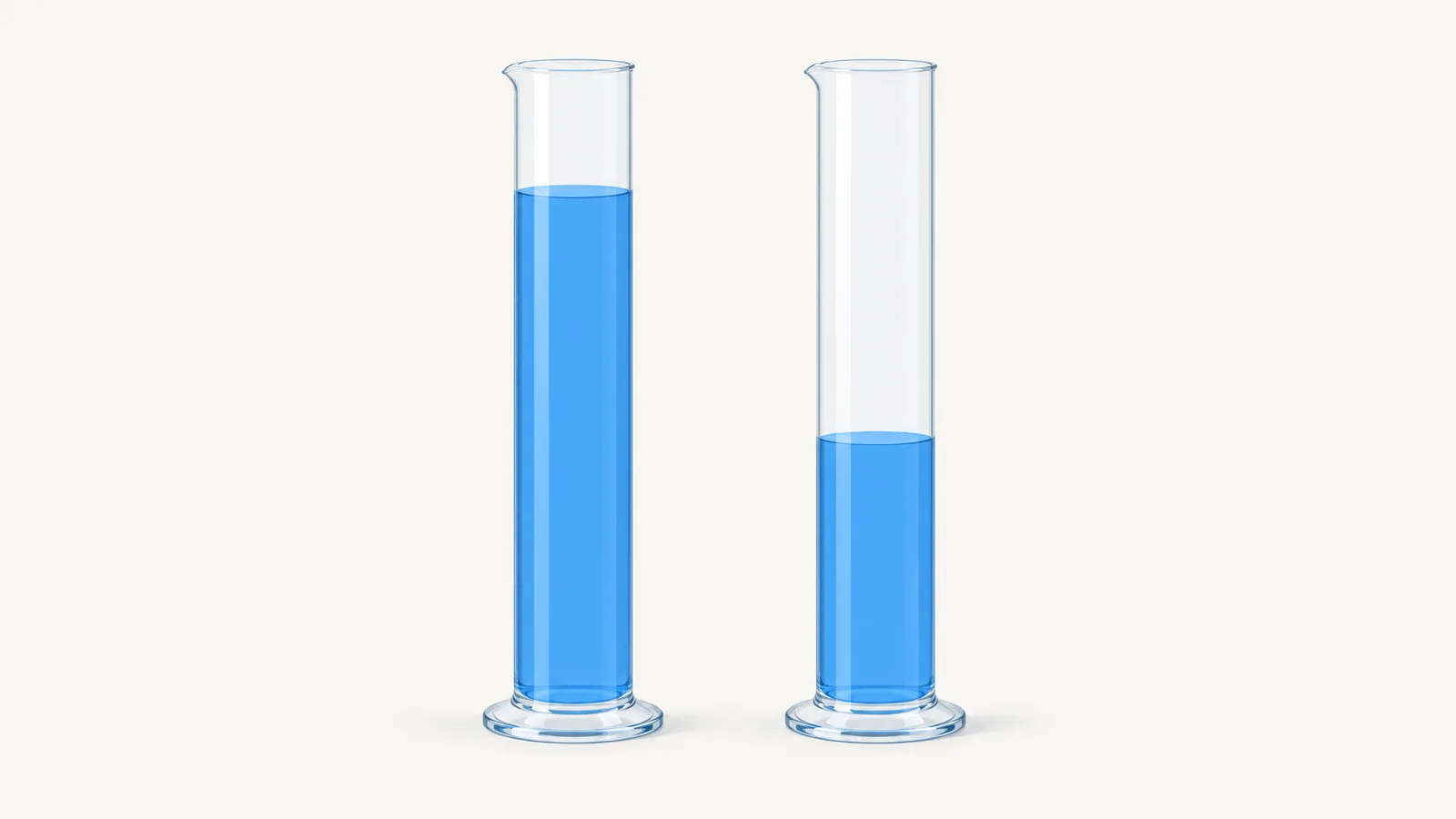
To make the percentages concrete, take someone who starts at 100 kg. A 20.2% loss is 20.2 kg and a 13.7% loss is 13.7 kg. That is an illustration of the arithmetic, not a figure from the trial, and real starting weights varied.
The authors also tested how many people reached weight-loss thresholds of at least 10%, 15%, 20% and 25%. Tirzepatide had the larger share at every one [1]. The published abstract does not give the exact shares, so we do not quote them here.
Side effects were mostly gastrointestinal in both groups. The authors describe most as mild to moderate and concentrated in the period when the dose was being raised [1].
A look at who lost weight fastest
A 2026 post hoc analysis of the same trial split participants by how quickly they lost weight. Rapid responders were those who had lost at least 15% of their body weight by week 24. Overall, 32.3% of participants met that definition: 44% of those on tirzepatide and 21% of those on semaglutide [2].
Rapid responders went on to reach higher weight-loss thresholds by week 72 than the others. They also had numerically more gastrointestinal and hepatobiliary adverse events, in both drug groups, yet completion of treatment was similar between rapid and non-rapid responders [2]. In both responder groups, a larger share of the tirzepatide arm reached every threshold than of the semaglutide arm [2].
Caveats
- Sponsor-run. Eli Lilly, which makes tirzepatide, funded SURMOUNT-5, and several of its authors work for the company [1]. The post hoc analysis also lists Lilly employees among its authors [2]. The weight data come from a scale, which is hard to bend, but an independent head-to-head would still add weight to this result.
- Open-label. Everyone knew which injection they were getting [1].
- Maximum tolerated dose. The doses were set by each person's tolerance, not by a fixed schedule, so the result describes the drugs as people could take them rather than at one identical dose.
- Post hoc. The rapid-responder analysis was run after the main trial and was not part of its original plan. Treat it as a pattern worth testing, not a finding [2].
- Seventy-two weeks. The trial says nothing about what happens after treatment stops, or about heart attacks, strokes or deaths.
What it means in practice
The SURPASS-2 result in diabetes and the SURMOUNT-5 result in obesity point the same way: tirzepatide produced more weight loss than semaglutide when the two were compared head to head [1][3]. Two separate randomised trials in two different populations pointing the same way is stronger than either alone.
For anyone weighing the two drugs, the sensible reading is size, not existence. Both drugs cut weight substantially. The open question is how far the 6.5-point gap survives outside a sponsor-run trial, and how it compares once cost, supply and individual side-effect tolerance are counted. Both are prescription medicines in the UK, so the choice between them sits with a prescriber. For the wider picture on each, see our tirzepatide guide and semaglutide guide.
What this means
We read SURMOUNT-5 as the cleanest head-to-head result so far, and the answer is that tirzepatide takes off more weight than semaglutide. We are confident in the direction, because it matches SURPASS-2 [3], and less sure of the exact size, because the sponsor ran an open-label trial. Take from it that the gap is real at these doses, with 6.5 points as the trial's own estimate. Do not take from it that either drug is without side effects, or that the number you read in a headline is the number you would get.
Educational content only — not medical advice. Many peptides discussed on HPR are not approved for human use. Talk to a qualified clinician before making any decision about your health.
References
- [1]Aronne LJ, Horn DB, le Roux CW, Ho W, Falcon BL, Gomez Valderas E, et al.. Tirzepatide as Compared with Semaglutide for the Treatment of Obesity. N Engl J Med 2025. doi:10.1056/NEJMoa2416394
- [2]Aronne LJ, Horn DB, Kokkinos AD, Falcon BL, Wang H, Hoffmann HT, et al.. Relationship of early rapid weight loss to efficacy and safety of tirzepatide and semaglutide for obesity: SURMOUNT-5 post hoc analysis. Am J Med 2026. doi:10.1016/j.amjmed.2026.03.010
- [3]Frías JP, Davies MJ, Rosenstock J, Pérez Manghi FC, Fernández Landó L, Bergman BK, et al.. Tirzepatide versus Semaglutide Once Weekly in Patients with Type 2 Diabetes. N Engl J Med 2021. doi:10.1056/NEJMoa2107519
Keep reading
Retatrutide: what the trials show so far, and what is still a press release
Peer-reviewed trials show 24% weight loss at 48 weeks and large falls in liver fat; the headline 28% phase 3 figure is still company-reported.
Cagrilintide and CagriSema: what the amylin trials found
Alone, cagrilintide cut weight by about 11% in 26 weeks; paired with semaglutide it reached 20% at 68 weeks, but lost a head-to-head against tirzepatide.
Tirzepatide: what SURMOUNT and SURPASS found
Around 20% average weight loss at 72 weeks, a clear head-to-head win over semaglutide, and heart-outcome data that holds up against an older GLP-1 drug.